

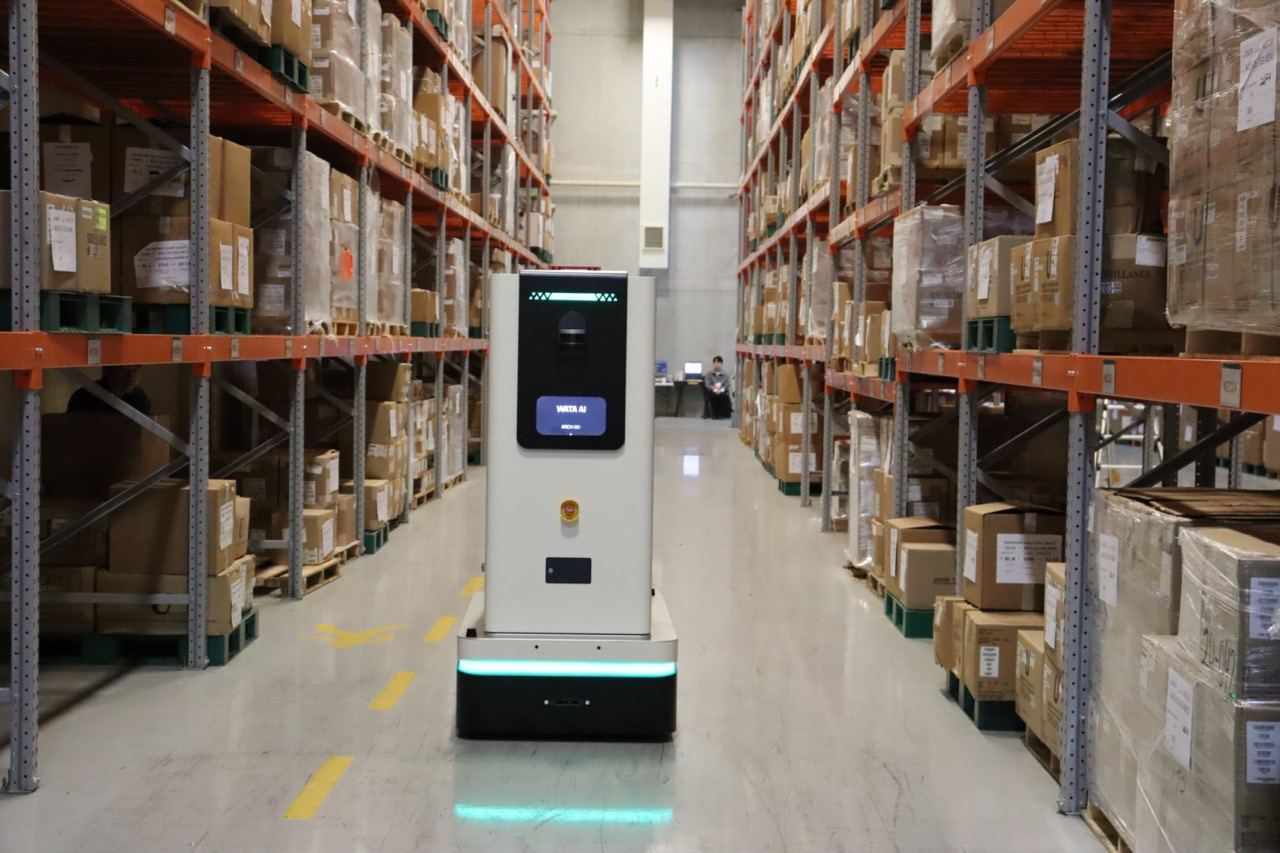
Inside a busy fulfilment centre, the hardest problem is often not lifting heavy shelves but traffic. Hundreds of low, flat robots glide beneath storage pods, carrying them to human pickers, and if every robot simply chose its own shortest route the aisles would lock up within minutes. Engineers are therefore teaching warehouse robots to share space more intelligently, using software that treats the floor like a living road network. Robots broadcast their intended paths, slow down early for crossings, and accept small detours that keep the whole fleet moving faster overall. In newly upgraded facilities, managers report that these cooperative behaviours have cut the pauses where robots wait nose to nose in narrow lanes, a surprisingly common cause of delayed orders. The systems also watch for the human factor, because staff on foot, forklifts and broken-down robots all create obstacles that no timetable can predict. Sensors on each unit scan constantly, and a robot that spots trouble can warn the fleet so others reroute before a queue forms behind it. The result feels less like a collection of machines following orders and more like a carefully choreographed flow designed to keep goods moving steadily.
What the Evidence Shows
Developers say the biggest gains came when they stopped optimising each robots journey in isolation and started measuring success at the level of the whole building. A route that is ten seconds longer for one robot can save a minute for twenty others, and the newer planning software makes exactly those trade-offs thousands of times a day. Testing happens first in detailed digital replicas of real warehouses, where engineers can unleash virtual rush hours, blocked aisles and sudden order surges without risking a single parcel. Only behaviours that survive simulation are pushed to the physical fleet, usually overnight in small groups. Battery management has improved alongside navigation, with robots scheduling their own charging breaks during natural lulls and topping up briefly rather than leaving the floor for long stretches. Operators are also learning to design buildings for robot traffic, widening key junctions and placing charging points where they will not obstruct peak flows. As online retailers promise ever faster delivery, the pressure on these systems will only grow. Reporting and analysis from sources such as IEEE Spectrum track the same developments, and specialists following the aisle-sharing warehouse robots say the direction is now consistent across independent lines of evidence.
The Wider Context
Adoption of the aisle-sharing warehouse robots follows a familiar pattern with an unfamiliar speed. Early users tolerate rough edges in exchange for advantage, mainstream users arrive when the tool disappears into existing workflows, and the market consolidates around whoever made that transition feel effortless. Vendors are racing less on raw performance now than on integration, support and trust.
What Happens Next
The realistic forecast for the aisle-sharing warehouse robots is steady integration rather than sudden replacement: embedded in products people already use, improving in increments, and regulated in proportion to its reach. The companies and institutions that plan on that basis, training staff and redesigning processes instead of chasing launches, are the ones the adoption data tends to vindicate. You can follow related developments in our coverage of technology.
It is also worth remembering how quickly the picture in this area has changed before. Positions that looked settled a few years ago have been revised as new data arrived, and the same humility is appropriate now. The strongest coverage of this subject, and the most useful advice, tends to come from sources that update their views openly when the facts move, rather than defending an earlier position long after it has stopped fitting the evidence available.
