

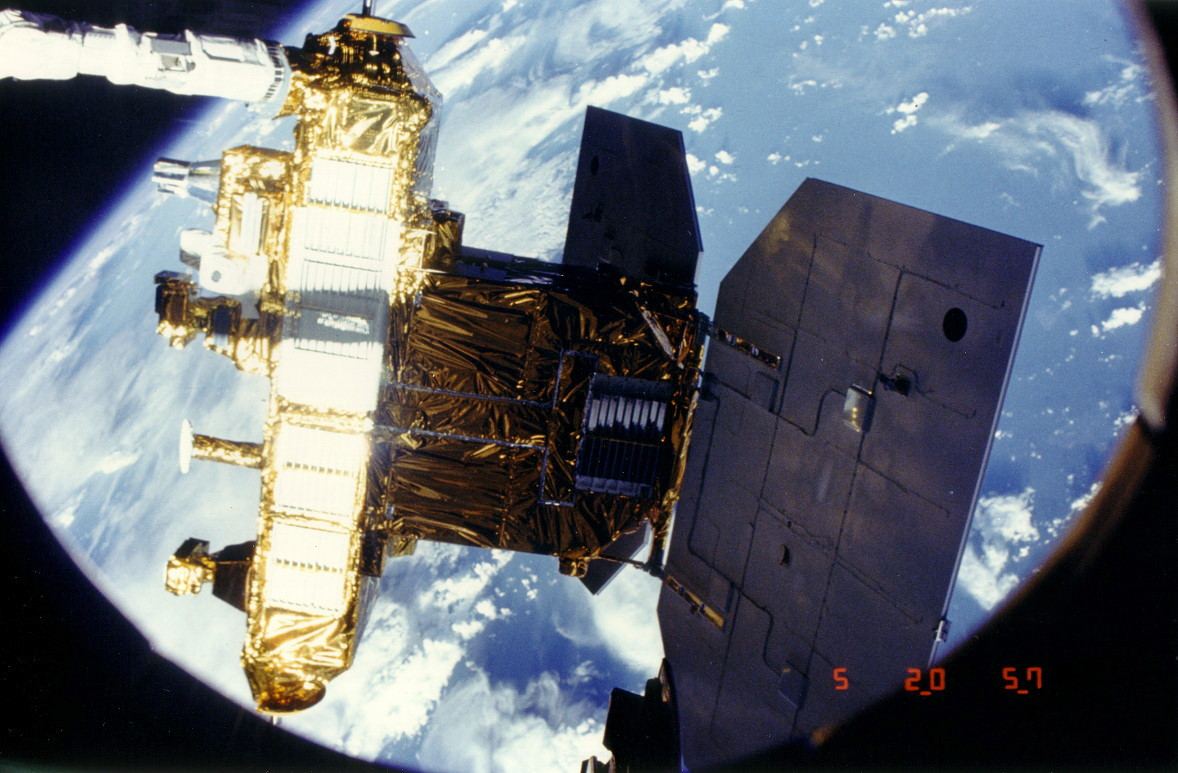
Google’s Project Suncatcher prototype satellite answered its first prompt in orbit on 30 October 2026, producing a haiku written by the onboard Gemma 4 open model. Google called it the first AI response from a data-centre-class TPU in orbit. The Planet-built satellite launched on 1 October 2026 aboard a SpaceX Falcon 9 from Vandenberg Space Force Base, as one of 130 payloads on the Transporter-18 rideshare, and Google confirmed contact the same day. The prompt was uplinked during a ground-station pass and the poem was downlinked as the satellite passed Svalbard, Norway. The design paper was published in the journal Joule on 1 October 2026, sketching a cluster of 81 satellites within one kilometre.
What the Evidence Shows
The fridge-sized spacecraft carries four Trillium TPUs, but only one runs at a time, for about 20 minutes, on about one kilowatt of solar power. That leaves its effective average compute at roughly 14 to 19 percent of a single NVIDIA H100, according to independent analysis of Google’s figures. In proton-beam tests, the TPUs survived a radiation dose equivalent to a five-year mission without permanent failures. Google plans to fly two satellites in 2027 to test laser links between them, as part of a long-term research moonshot into orbital data centres. Google calls Suncatcher a long-term research moonshot and one of several proposals for orbital data centres, exploring whether continuous solar power in space can bypass the energy constraints that limit data centres on Earth. Reporting and analysis from sources such as IEEE Spectrum track the same developments, and specialists following the Google Project Suncatcher orbital TPU say the direction is now consistent across independent lines of evidence.
The Wider Context
Adoption of the Google Project Suncatcher orbital TPU follows a familiar pattern with an unfamiliar speed. Early users tolerate rough edges in exchange for advantage, mainstream users arrive when the tool disappears into existing workflows, and the market consolidates around whoever made that transition feel effortless. Vendors are racing less on raw performance now than on integration, support and trust.
What Happens Next
The realistic forecast for the Google Project Suncatcher orbital TPU is steady integration rather than sudden replacement: embedded in products people already use, improving in increments, and regulated in proportion to its reach. The companies and institutions that plan on that basis, training staff and redesigning processes instead of chasing launches, are the ones the adoption data tends to vindicate. You can follow related developments in our coverage of technology.
It is also worth remembering how quickly the picture in this area has changed before. Positions that looked settled a few years ago have been revised as new data arrived, and the same humility is appropriate now. The strongest coverage of this subject, and the most useful advice, tends to come from sources that update their views openly when the facts move, rather than defending an earlier position long after it has stopped fitting the evidence available.
