

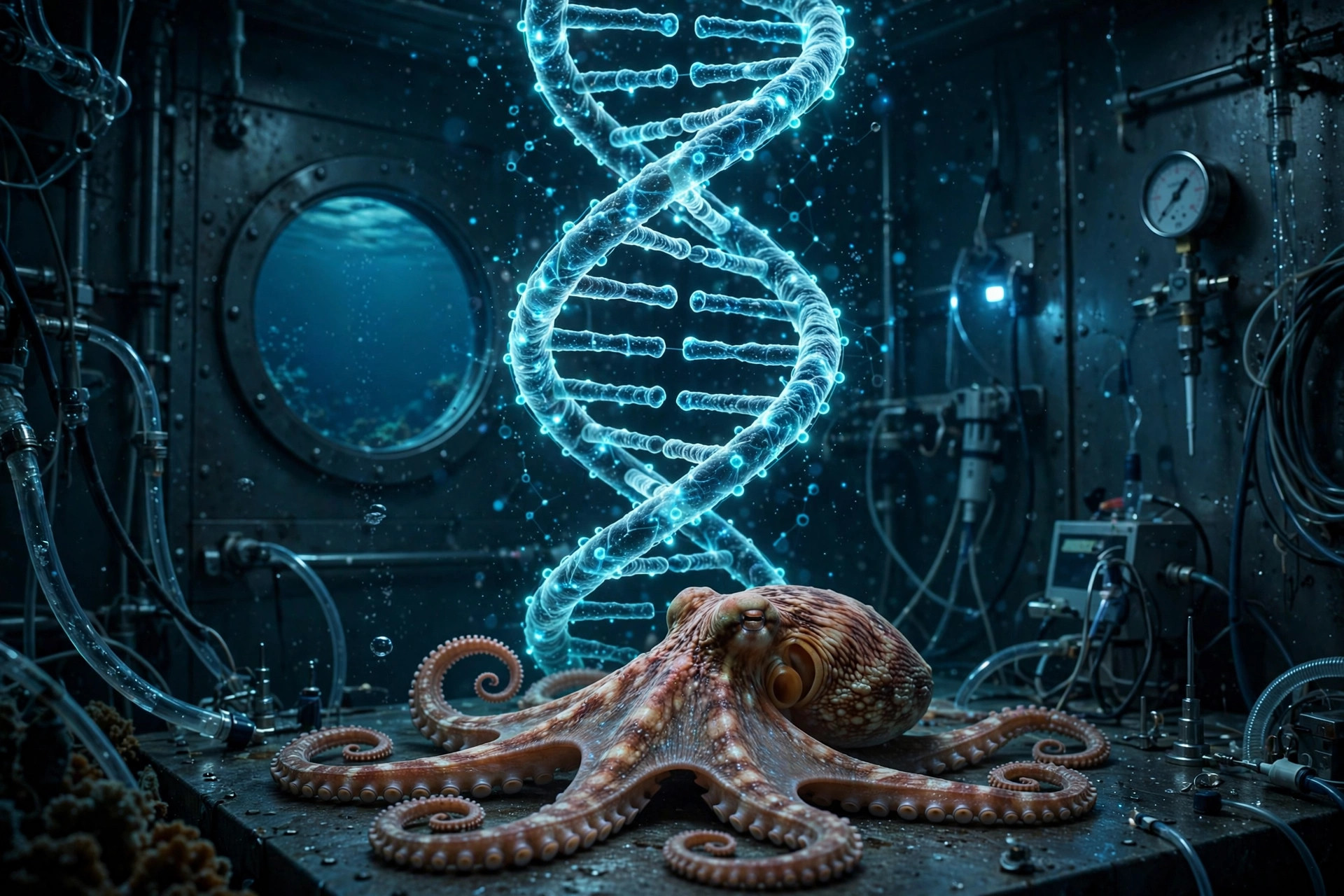
Octopuses can solve puzzles, squid can change colour in an instant, and cuttlefish can blend into surroundings that they have never seen before. For biologists, that intelligence has long posed a puzzle of its own: how did animals so distant from vertebrates evolve such elaborate nervous systems? New research from the University of Vienna suggests part of the answer may lie not only in which genes cephalopods carry, but in how their DNA is folded inside the cell.
The study, published in Nature Communications, examined the three-dimensional organisation of the genome in octopus, squid and cuttlefish, the group known as coleoid cephalopods. By combining maps of DNA structure with data on gene activity, the researchers traced what happened after an ancient burst of genome reorganisation hundreds of millions of years ago. That reshuffling, they found, changed which parts of the genome could influence one another, and those new relationships may have helped shape the cephalopod brain.
A Genome Is More Than a List of Genes
DNA is often described as an instruction book, but the metaphor can be misleading if it suggests a simple, linear text. Inside a cell nucleus, long strands of DNA are folded, looped and packed into a complex three-dimensional shape. That shape matters because genes are switched on and off by regulatory elements that may sit far away along the sequence. When folding brings a distant element close to a gene, the two can interact in ways that a flat sequence map would never predict.
Lead author Dr Thea Rogers and her colleagues argue that understanding this architecture is becoming essential for understanding how new biological complexity arises. In cephalopods, the ancient reorganisation moved large sections of chromosomes around. Regions that had once been far apart were suddenly neighbours, creating opportunities for new regulatory connections that did not exist in their ancestors.
The idea fits a wider shift in genetics, where researchers increasingly study structure alongside sequence. It is a reminder, much like the frontier work explored in coverage of quantum leaps from vision to innovation, that breakthroughs often come when scientists look at a familiar problem in a completely new dimension.
Regulatory Entanglement
The team describes the resulting process as regulatory entanglement. When reshuffled regions of DNA came into contact, they could begin to affect each other’s activity. Over evolutionary time, some of those chance encounters became established, forming networks in which many genes and regulators are interconnected. Such networks can produce new patterns of gene expression while still preserving the essential functions an animal needs to survive.
That balance between novelty and stability may be crucial. A genome that never changes cannot innovate, but a genome in which every change disrupts vital systems will not survive. Entanglement, the researchers suggest, offered cephalopods a middle path: new connections could be tested and refined in parts of the genome linked to new traits, while core functions remained protected by more stable structures.
Not every level of genome organisation behaved the same way. Large structural units known as chromatin domains were remarkably stable across species, tissues and stages of development. By contrast, finer connections called chromatin loops were far more dynamic. These loops, which pull distant stretches of DNA together, varied widely and were often found near genes involved in distinctive cephalopod traits, including genes linked to the nervous system.
Why Loops May Matter for Brains
The contrast between stable domains and flexible loops is one of the study’s most intriguing findings. It suggests a kind of layered architecture: a conserved framework that keeps the genome organised, topped by adaptable connections that can evolve quickly. If loops near nervous-system genes changed readily after the ancient reshuffling, they could have helped produce new patterns of brain development without requiring entirely new genes to appear.
Cephalopods are famous for doing evolution differently. They have large brains relative to their bodies, sophisticated eyes, flexible arms and, in many species, an extraordinary ability to edit their own RNA. The Vienna work does not claim that genome folding explains all of that. Instead, it proposes that three-dimensional organisation was an active driver, helping to convert a period of genomic upheaval into lasting biological innovation.
Readers can explore the university’s summary of the work in its report on how the 3D structure of DNA may explain cephalopod brains, and the full paper is available through Nature Communications.
A New Lens on Evolution
The findings challenge a common assumption that genome architecture is merely a passive by-product of evolution, a shape that emerges after genes have changed. Here, architecture appears to be part of the mechanism itself, influencing which genes can work together and therefore which new traits can emerge. That perspective could influence research far beyond cephalopods, prompting scientists to ask whether similar folding changes played a role in other evolutionary leaps, from flight in birds to cognition in mammals.
Many questions remain. Researchers will need to test how specific loops affect specific genes, and to compare cephalopod development in much finer detail across species. Yet the central message is already clear: to understand how an octopus became so clever, it may not be enough to read its DNA. Scientists also need to see how that DNA folds, touches and talks to itself across the crowded space of the cell.
