

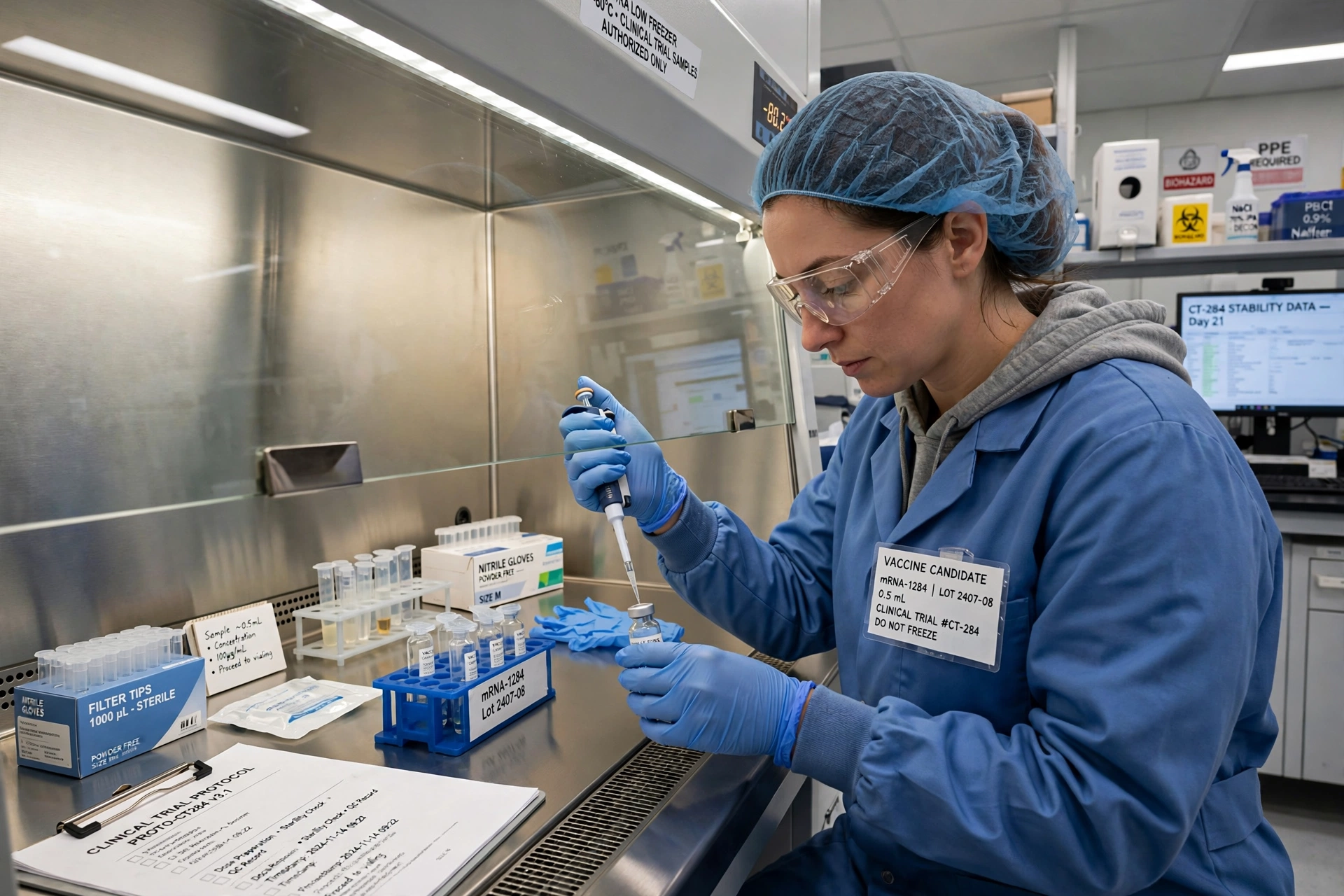
Filed under early evidence, carefully labelled: a personalised neoantigen vaccine named NeoVax, made from each patient’s own tumour mutations and given with the checkpoint inhibitor nivolumab, has been tested in a phase 1 trial in platinum-sensitive recurrent ovarian cancer. The study, published in Nature Medicine, reports that the vaccines could be manufactured and administered, that safety was acceptable, and that T-cell responses were observed.
The notes below record what the trial was designed to show, what it found, and — with equal emphasis — what it did not attempt to prove. In a subject where hope travels faster than data, precision is a form of respect for the reader.
The concept, in brief
Tumours accumulate mutations. Some mutations produce neoantigens, abnormal protein fragments displayed by cancer cells and absent from healthy tissue. A neoantigen vaccine attempts to train the patient’s immune system to recognise those fragments as targets. Because each tumour’s mutations differ, NeoVax is manufactured individually: tumour analysis first, prediction of the most promising targets second, production of a one-person vaccine third.
Nivolumab’s role is complementary. As a PD-1 immune checkpoint inhibitor, it blocks a signalling pathway that tumours use to restrain T cells. The vaccine supplies direction; the inhibitor aims to sustain the attack. Whether the pairing improves outcomes is a question for later trials, not this one.
What the record shows
Three findings are documented. Feasibility: the complex manufacturing chain functioned, and patients in the trial received their personalised vaccines. Safety: adverse effects were within the range investigators considered acceptable for an early-phase combination. Immunogenicity: monitoring detected T-cell responses, evidence that the immune system registered the vaccine’s targets.
The study report in Nature Medicine contains the full methodology. General reference material on ovarian cancer is maintained by the National Institutes of Health.
What the record does not show
No efficacy conclusion can be drawn, and none is offered here. Phase 1 trials are small, are designed around safety and practicality, and lack the comparisons needed to attribute changes in disease to treatment. The study does not establish that NeoVax shrinks tumours, delays recurrence or extends life — nor that the vaccine, rather than nivolumab or patient selection, drove any clinical observation. Any account suggesting otherwise has outrun its source.
This discipline will be familiar to readers of our health notes, including our summary of how technology is changing breast cancer detection: promising mechanisms are common; demonstrated patient benefit is rarer and slower to arrive.
Why feasibility is not a trivial result
It would be easy to file “we succeeded in giving the treatment” as administrative. It is not. A therapy that exists only as a design — however elegant — helps no one. Demonstrating that tumour tissue can be turned into a compliant, deliverable vaccine within the realities of a clinical trial removes a genuine point of failure for the entire approach. It also generates practical knowledge about timelines and production that any successor study will depend on.
Ovarian cancer that has recurred after platinum-based therapy remains a setting of limited options, which is why workable new platforms attract sustained attention even at this preliminary stage.
Closing note
The accurate summary is short: NeoVax plus nivolumab is feasible to deliver, acceptably safe in early testing, and capable of prompting immune responses in platinum-sensitive recurrent ovarian cancer. Larger trials must now determine whether those responses matter clinically. Until they report, this entry stays where the evidence puts it — promising, preliminary, and unfinished.
A note on language
Coverage of trials like this one often reaches for words — breakthrough, game-changer, hope — that the underlying paper does not use. The Nature Medicine report’s own vocabulary is feasibility, safety and immune response, and this account has deliberately stayed inside it. That restraint is not a lack of sympathy for patients with recurrent ovarian cancer, whose need for better options is urgent and real. It is the opposite: people making decisions under pressure deserve reporting that distinguishes a treatment that can be given from a treatment that has been shown to help. The next entries in this story will come from larger trials, and they will be noted here with the same care, whatever they find.
