

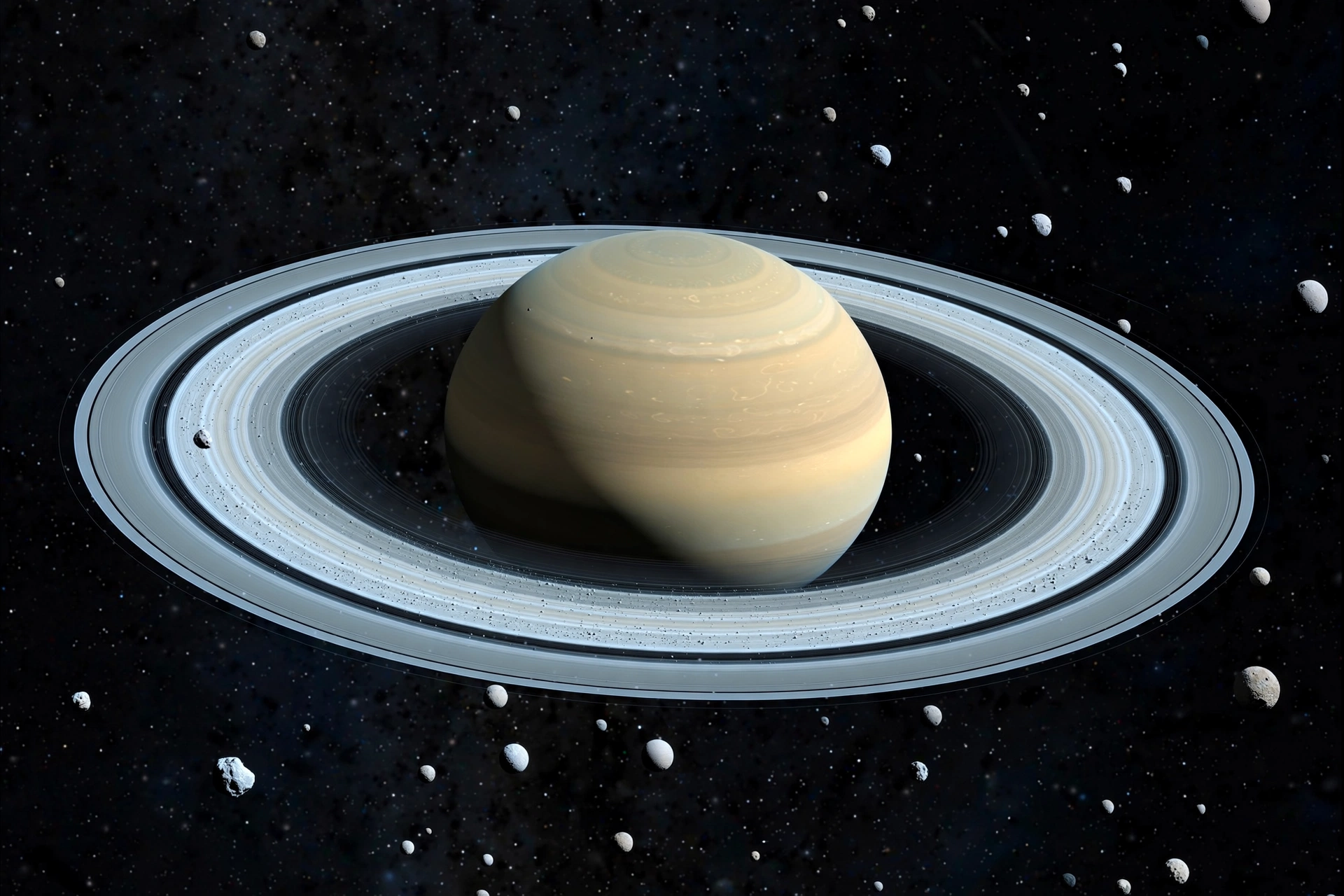
There is a particular pleasure in a fact that rearranges a familiar picture. Saturn — the planet of school posters, defined by its rings — turns out to be orbited by at least 274 moons. Astronomers have confirmed 128 new ones, raising the total from 146 and putting Saturn ahead of all the other planets combined. Noted carefully, the detail is even better than the headline: most of the newcomers are fragments, pieces of larger moons that broke apart.
This journal-style account sets out what was found, how the survey worked, and why researchers think a large share of Saturn’s extended family began as wreckage.
The observation, recorded
The moons were confirmed from a survey conducted with the Canada-France-Hawaii Telescope on Mauna Kea, Hawaii, with a team including Dr Edward Ashton of the University of British Columbia. The observations spanned several years. Because each moon is only a few kilometres across and extraordinarily faint, the astronomers relied on a technique called shift and stack: exposures are shifted to match Saturn’s motion, then stacked, so the light of a real moon builds into a visible signal while noise averages away.
Candidates were followed until their orbits were established, after which the International Astronomical Union recognised them formally. The observatory’s role is described by the Canada-France-Hawaii Telescope.
The character of the irregulars
The confirmed moons belong to the class astronomers call irregulars. Their orbits are distant from Saturn, tilted at pronounced angles, and in many cases retrograde — they circle the planet in the opposite sense to its rotation and to the stately procession of its major moons.
Regular moons are thought to have formed with Saturn, condensing from the disc of material around the young planet into orderly paths. Irregular orbits tell a different origin story: capture. A body formed elsewhere in the solar system strayed into Saturn’s gravitational reach and never left. The tilt and the backward motion are the retained evidence of that arrival, preserved because so little disturbs orbits at those distances.
Students of complex systems will find a pleasing parallel in our earlier notes on how cephalopod DNA folds into three-dimensional structures behind complex brains — in both cases, structure is a record of history, readable if you know how to look.
Collision families
The survey’s most suggestive finding is that many of the new moons travel in related groups, sharing orbital traits too specific to be coincidence. The standard interpretation is fragmentation. A captured moon, perhaps tens of kilometres wide, was struck and shattered; its fragments continued in similar orbits, slowly dispersing but still recognisable as kin.
This reframes Saturn’s retinue. Rather than 274 independent objects, the system is partly a set of families, each family a collision rendered permanent. Dating those break-ups — from how far the fragments have spread — gives planetary scientists a chronology of violence in the outer solar system that no other evidence could supply.
A note on completeness
Two cautions belong in any honest record. First, 274 is a floor, not a ceiling: smaller fragments below the survey’s sensitivity almost certainly exist. Second, totals for the other giant planets partly reflect how hard astronomers have looked; Saturn has received exceptional attention. Neither caution diminishes the result. The documented population has nearly doubled, and the International Astronomical Union’s recognition makes the count official rather than speculative.
What remains is follow-up work: refined orbits, firmer family groupings, and eventually names. Saturn will keep its rings on the posters. But the fuller portrait — a giant planet attended by hundreds of captured, tilted, shattered little worlds — is the one the evidence now supports, and it is considerably more interesting.
An entry for the long record
It is worth pausing on the timescale involved. The survey itself ran for years; the collisions it documents may have happened millions or billions of years ago; the fragments will continue on their tilted paths for ages after every current telescope has been retired. Astronomy routinely works across such spans, but rarely with this neat a correspondence between effort and evidence: a few years of careful watching, written into a catalogue, describing events from deep time. The 128 moons were not created by the survey. They were, in the fullest sense, merely noticed — and noticing, done rigorously, is what turned them from scattered light into knowledge.
